247
Boeing
Historical Context & Origins
In the early 1930s, commercial aviation was still dominated by wood-and-canvas biplanes, which were slow, noisy, and limited in capacity. The need for faster, safer and more efficient aircraft was pressing, pushing the industry into an era of radical innovation. The Boeing 247 emerged from this ferment, representing a bold vision of the future of air travel.
With its first flight in 1933, the Boeing 247 was not a simple evolution, but a real revolution. Designed by the Boeing Airplane Company, this aircraft was conceived to overcome the structural and performance limitations of its predecessors, introducing concepts that would shape aviation for decades to come. It was the embodiment of technological progress applied to civil flight.
Architecture & Technological Design
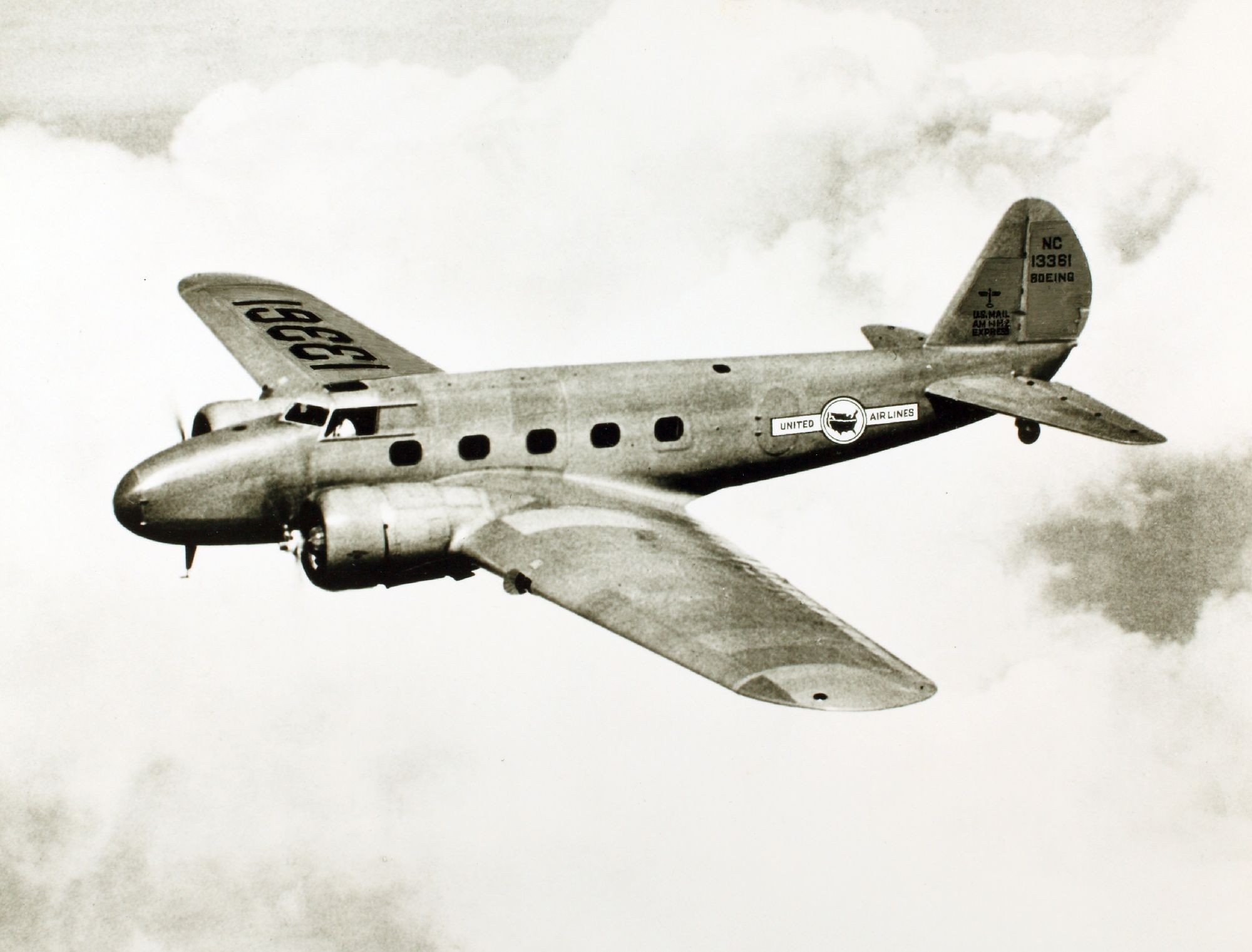
The Boeing 247 was a pioneer in the true sense of the word, immediately distinguishing itself for its futuristic architecture. Abandoning the construction logic of the past, it adopted a semi-monocoque entirely metal structure, a huge leap compared to the canvas and wood aircraft in vogue at the time. This choice guaranteed greater resistance, durability and a significant reduction in structural weight.
Its design included an elegant twin-engine low-wing configuration, which not only improved aerodynamics but also safety by providing propulsive redundancy. The introduction of retractable landing gear was another revolutionary element, eliminating the cumbersome aerodynamic resistance of fixed landing gear and allowing cruising speeds unthinkable for the time. Every aspect was optimized for efficiency.
Onboard Specifications
- ◆All-metal semi-monocoque structure: A fundamental innovation that provided strength and lightness, defining a new construction standard for airliners.
- ◆Retractable landing gear: Crucial element for reducing aerodynamic drag, significantly increasing speed performance and fuel consumption.
- ◆Variable-pitch propellers: They improved the efficiency of the engines in different phases of flight, optimizing thrust for take-off and reducing fuel consumption in cruise, although initially they were only an option.
Operational Career & Operators
The Boeing 247 entered service with Boeing Air Transport, later merged into United Air Lines, the parent airline. Its speed and reliability radically changed the experience of air travel, making continental crossings much quicker and more comfortable. It could accommodate 10 passengers and two crew members, setting new standards of service.
Despite its excellent qualities, Boeing made a decision that limited its diffusion: the 59 examples produced were initially destined almost exclusively to the companies of its own group, leaving the market open to competitors. This strategic choice paved the way for the success of the Douglas DC-2 and, later, the legendary DC-3, which would soon surpass the 247 in terms of capacity and autonomy, despite inheriting many of its design principles.
Legacy & Cultural Impact
Although the Boeing 247 was quickly overtaken by larger, higher-performance aircraft, its historical importance is undeniable. It was the first truly modern airliner, the prototype that demonstrated the commercial and technical feasibility of high-speed passenger air transport. Every subsequent airliner, in one way or another, is indebted to the innovations introduced by the 247.
The impact of the Boeing 247 on aviation was not only technical, but also cultural. It proclaimed the beginning of a new era of air travel, transforming flying from a risky adventure to a reliable and, for its time, luxurious means of transportation. It is a milestone that, while not the longest-standing or most widespread, remains a symbol of the ingenuity and vision that shaped modern aviation.
Telemetria Specs (HUD)
Hangar Trivia & Curiosità
- 💡Only 60 Boeing 247 aircraft were ever built, primarily for Boeing Air Transport (a precursor to United Airlines), due to Boeing's policy of limiting sales to competitors.
- 💡A Boeing 247-D won the transport section of the 1934 MacRobertson Air Race from England to Australia, demonstrating its advanced capabilities and speed on a global stage.
- 💡Its groundbreaking features, though initially giving it an advantage, were quickly adopted and improved upon by rival manufacturers, most notably Douglas with its DC-2 and DC-3, which eventually overshadowed the 247 in production numbers.
Archivio Avvistamenti Spotter
Immagini scattate dalla community in tutto il mondo


