228-100
Dornier
Historical Context & Origins
At the dawn of the 1980s, the aviation industry was in turmoil, looking for innovative solutions for regional transport and special missions. In this scenario, Dornier GmbH, a historic name in German engineering, began the development of an aircraft that would redefine the utility aircraft segment. The project aimed to combine reliability with cutting-edge performance, drawing on the experience accumulated with previous models such as the Do 28 Skyservant.
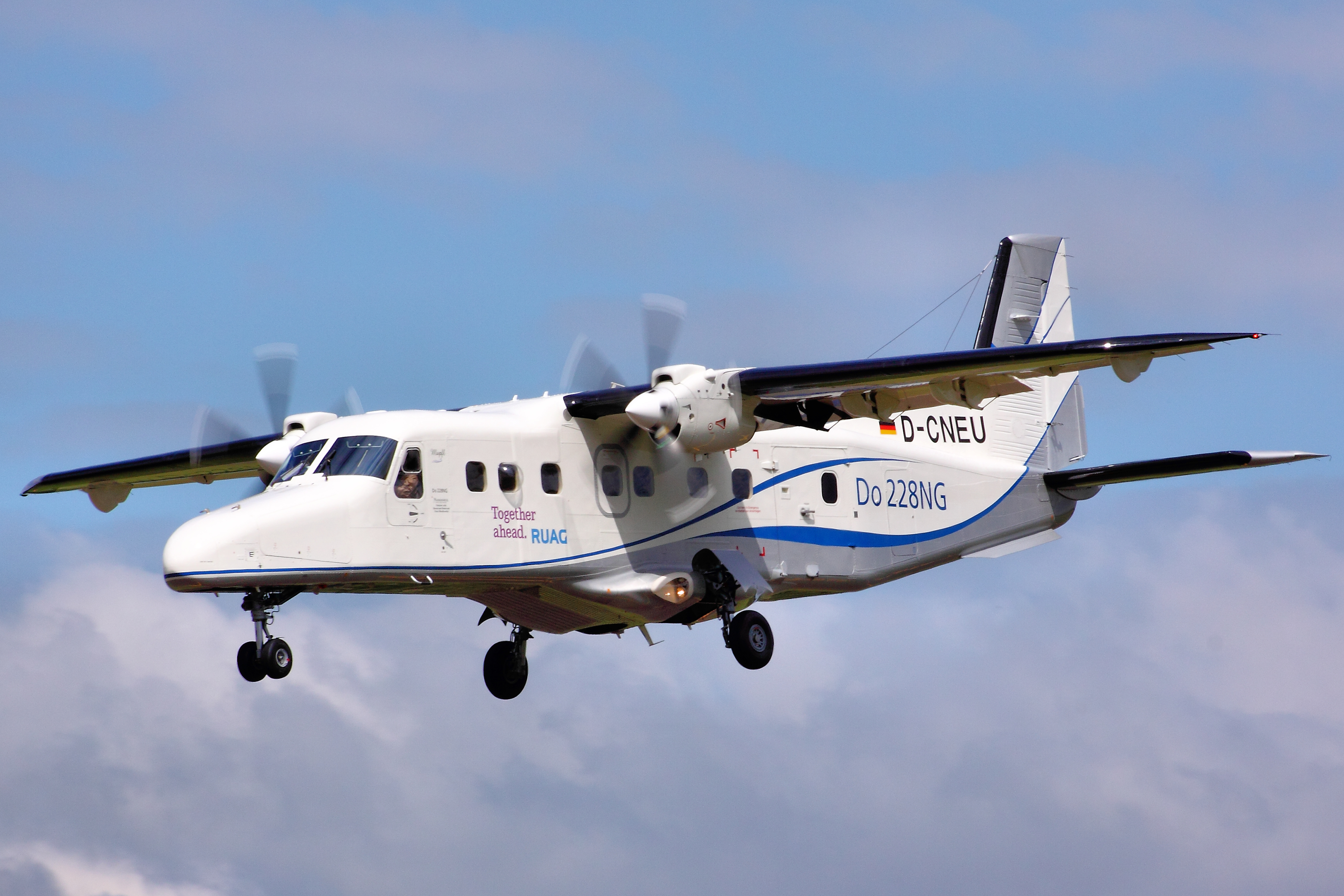
The Dornier 228-100 made its first flight on 28 March 1981, presenting itself to the world as a promise of efficiency and versatility. It arose from the need for a modern, cost-effective aircraft capable of operating from short and poorly prepared runways, meeting the needs of regional airlines, government bodies and military operators. It was a bold step for Dornier, which invested significantly in new aerodynamic technologies.
Architecture & Technological Design
The heart of the innovation of the Dornier 228-100 lay in its aerodynamic architecture, in particular in the adoption of the revolutionary Do 228 supercritical wing, also known as TNT (Tragflügel Neuer Technologie – New Technology Wing). This technology, the result of in-depth research, allowed the aircraft to achieve superior aerodynamic efficiency, with a significant reduction in drag and a notable improvement in STOL (Short Take-Off and Landing) performance.
The structural robustness, made entirely of metal alloys, guaranteed the Dornier 228-100 a long operational life and simplified maintenance, crucial aspects for carriers operating in harsh conditions. The fuselage, with a square and non-pressurised section, was designed to maximize the cargo volume and allow rapid reconfiguration of the interior, transforming it from a passenger aircraft to a cargo plane or a platform for special missions in a very short time.
Under each wing, the Dornier 228-100 was equipped with two reliable Garrett (now Honeywell) TPE331-5-252D turboprop engines, capable of producing 715 horsepower each. These engines, combined with the efficiency of the TNT wing, gave the aircraft excellent climb capabilities and a competitive cruise speed, all while maintaining low fuel consumption and high operational reliability, essential for regional routes and in remote environments.
Onboard Specifications
- ◆Supercritical Wing TNT (Tragflügel Neuer Technologie): Maximum aerodynamic efficiency and superior STOL performance.
- ◆Garrett TPE331-5 Turboprop Engines: Reliability, fuel efficiency and adequate power for short takeoffs.
- ◆Modular and Robust Structure: Facilitates maintenance and allows rapid internal reconfiguration for different missions.
Operational Career & Operators
The Dornier 228-100 quickly established itself as a global workhorse. Thanks to its extraordinary versatility and ability to operate from unpaved runways, it has found use in myriad contexts: from regional airlines serving small communities, to governments for VIP transportation or logistical support. Its robustness made it ideal for operating in extreme environments, from the Arctic to African deserts.
Many carriers, large and small, have appreciated its operational economy and reliability. It has been adopted by armed forces for maritime surveillance, search and rescue (SAR) and light tactical transport. Even scientific and research bodies, such as the DLR (German Aerospace Center), have used it as a flying platform for experiments and environmental monitoring, demonstrating its flexibility in highly specialized roles.
Legacy & Cultural Impact
The Dornier 228-100 left an indelible mark on aviation history, serving as a pioneering testbed for the TNT wing that influenced the development of future regional and utility aircraft. Its ingenious combination of advanced aerodynamic technology and operational practicality proved that efficiency and versatility could coexist in a single design.
Its legacy is so strong that the Dornier 228 is still in production, now as Dornier 228 NG (New Generation) or Dornier 228 Classic under the license of RUAG Aerospace in Switzerland and by Hindustan Aeronautics Limited (HAL) in India. This is testament to the foresight of the original design and its ability to adapt to new market needs, maintaining its relevance over forty years after its first flight. The Dornier 228-100 is not just an aircraft, but a symbol of German engineering, recognized and respected throughout the aeronautical world.
Telemetria Specs (HUD)
Hangar Trivia & Curiosità
- 💡The 'TNT' (Tragflügel Neuer Technologie - Wing of New Technology) wing was a major innovation, significantly improving lift and reducing drag for the aircraft.
- 💡Known for its excellent STOL capabilities, the Do 228 can operate from very short, unprepared, or austere runways, making it ideal for remote areas.
- 💡Beyond passenger and cargo transport, the Dornier 228 has been extensively used for maritime surveillance, environmental monitoring, and scientific research missions, including in polar regions.
Archivio Avvistamenti Spotter
Immagini scattate dalla community in tutto il mondo