1900C
Beechcraft
Historical Context & Origins
The Beechcraft 1900C, with its first flight in 1982, emerged as a strategic response to the growing need for an efficient and robust regional airliner. Designed by the renowned Beechcraft, a division of Raytheon, this model filled the void left by smaller aircraft and opened up new routes for the "commuter" airlines of the time.
Inheriting the Beechcraft King Air's solid reputation for reliability, the 1900C was designed to overcome the capacity limitations of previous models, such as the Beechcraft 99. The goal was to offer a pressurized twin engine with greater capacity, while maintaining the low operating costs and versatility that had distinguished its predecessors.
The "C" variant was notable for the introduction of significant structural and aerodynamic improvements, laying the foundations for a family of aircraft that would dominate the regional transport sector for decades. Its design was focused on maximizing cost-effectiveness and the ability to operate in different environmental conditions.
Architecture & Technological Design
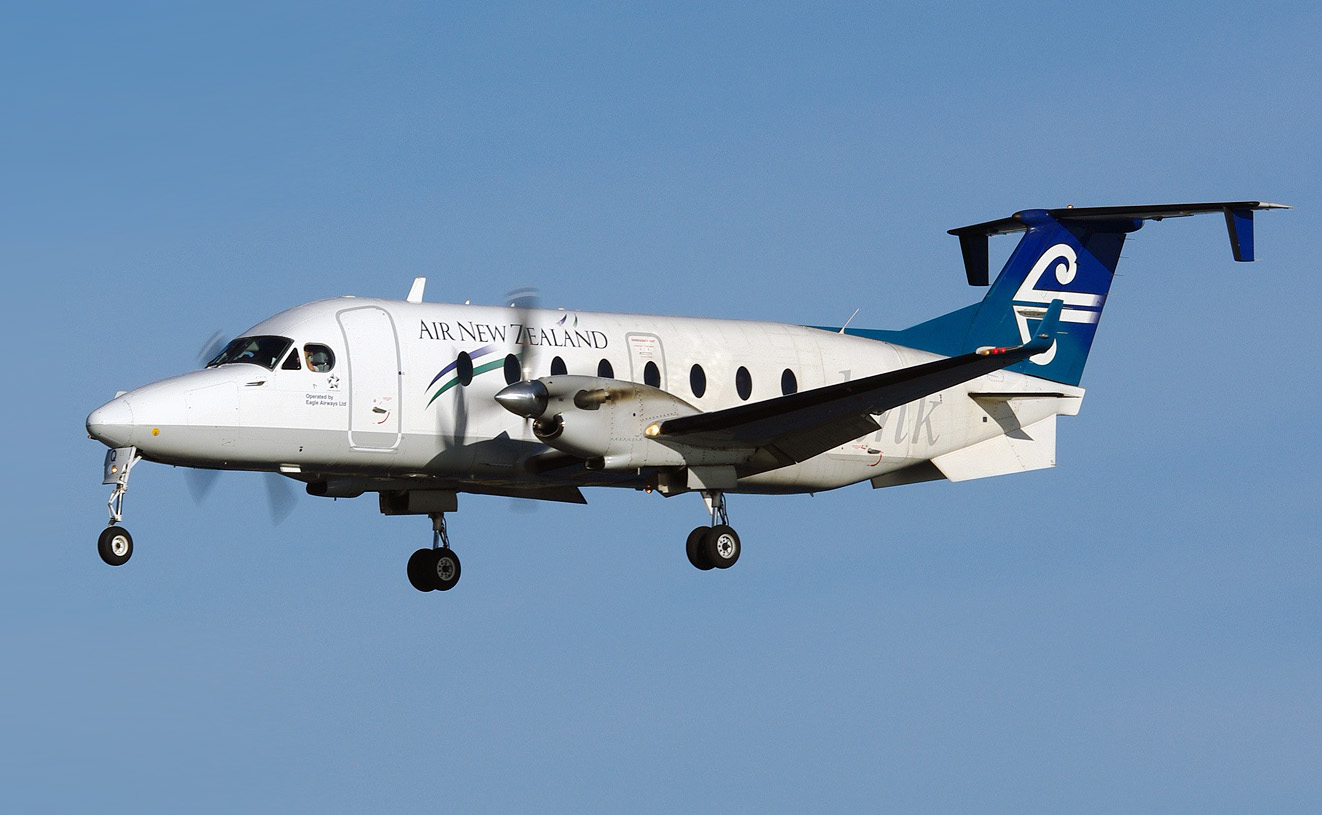
The architecture of the Beechcraft 1900C is based on a classic regional airliner configuration, with a stretched fuselage capable of accommodating 19 passengers. The structure entirely in aluminum alloy guaranteed sturdiness and exceptional durability, essential for the stress cycle imposed by frequent take-off and landing operations.
The technological design was focused on reliability and performance. The cantilever wings, equipped with an optimized aerodynamic profile, ensured excellent flight characteristics at different speeds and altitudes. The distinctive T-tail contributed to directional stability and the reduction of aerodynamic interference during the cruise phase.
Propulsion was entrusted to a pair of Pratt & Whitney Canada PT6A-65B turboprop engines, synonymous with power, efficiency and legendary reliability in the world of aviation. These engines allowed the 1900C to achieve excellent cruising speed and considerable range, making it ideal for connecting remote communities and larger cities.
Onboard Specifications
- ◆Pratt & Whitney Canada PT6A-65B engines: The choice of these twin-turbine engines guaranteed exceptional performance and unparalleled operational robustness.
- ◆Pressurized cabin for 19 passengers: Significant comfort for the time, allowing flights at higher altitudes with a superior travel experience.
- ◆Reinforced landing gear: Designed to withstand frequent landing and takeoff cycles, even on less prepared runways, maximizing operational flexibility.
Operational Career & Operators
The operational career of the Beechcraft 1900C was an immediate success. Its versatility made it a mainstay for countless regional airlines around the world, from North America to Africa, Asia to Oceania. Its ability to operate from short runways and its reliability made it indispensable in areas with limited airport infrastructure.
Many carriers, large and small, have employed the 1900C for their local and feeder routes. Among these, companies such as CommutAir, Rocky Mountain Airways and Air Labrador have made it a key element of their fleets, leveraging its operating economics to connect communities and power major hubs.
In addition to passenger transport, the Beechcraft 1900C has also proven highly adaptable for light cargo roles, corporate transport and special missions, including medical and surveillance flights. Its operational longevity is a testament to the validity of its design and its inherent robustness.
Legacy & Cultural Impact
The Beechcraft 1900C has left a lasting legacy in the regional aviation landscape. It paved the way for its successor, the Beechcraft 1900D, introducing design and operating concepts that have become industry standards. Its ability to democratize regional air travel is undeniable.
The 1900C's cultural impact lies in its image as a reliable "workhorse", an aircraft that connected remote communities and supported economic development in many regions. It helped define the archetype of the modern, efficient and safe regional airliner.
Although progressively replaced by newer models or the 1900D, the 1900C continues to fly in many parts of the world, a testament to its exceptional durability and timeless design. Its history is a fundamental chapter in the evolution of regional air transport.
Telemetria Specs (HUD)
Hangar Trivia & Curiosità
- 💡Over 695 units of all 1900 variants were built, making it one of the most successful regional airliners ever produced.
- 💡The 1900C is renowned for its ability to operate from shorter and sometimes unpaved runways, enhancing its utility in remote areas.
- 💡It shares many components and its basic airframe design with the Beechcraft Super King Air, simplifying maintenance and pilot training.
Archivio Avvistamenti Spotter
Immagini scattate dalla community in tutto il mondo
Vettori Rilevati (Flotta Attiva)


Alaska Central Express
In Flotta: x5 u.
Alpine Air Express
In Flotta: x12 u.
Ameriflight
In Flotta: x20 u.

Central Mountain Air
In Flotta: x5 u.
Exploits Valley Air Services
In Flotta: x5 u.
Gum Air
In Flotta: x3 u.
Jonair
In Flotta: x2 u.
North Cariboo Air
In Flotta: x5 u.
Northern Thunderbird Air
In Flotta: x3 u.
Pacific Coastal Airlines
In Flotta: x5 u.
Propair
In Flotta: x3 u.
Searca
In Flotta: x3 u.
SkyLink Express
In Flotta: x5 u.
Trans Guyana Airways
In Flotta: x3 u.